Looking to understand HES to MDM integration in Smart Metering? This article covers everything you need to know from architecture and data flow to MDM functionalities, integration challenges, and best practices.
As smart metering deployments continue to grow across utilities worldwide, seamless integration between the Head End System (HES) and Meter Data Management (MDM) has become one of the most critical components of an Advanced Metering Infrastructure (AMI).
While the HES is responsible for collecting data from millions of smart meters, the MDM transforms this raw information into validated, bill-ready, and business-ready data that can be consumed by billing, customer service, outage management, and analytics systems.
This article explains the complete HES-to-MDM integration process, including architecture, data exchanged, integration methods, common challenges, and best practices.
What is HES to MDM Integration?
HES to MDM Integration is the process of securely transferring meter readings, events, alarms, and device information collected by the Head End System (HES) to the Meter Data Management (MDM) platform.
The primary objective is to perform:
- VEE (Validation, Estimation & Editing)
- Data Storage
- Data Quality Management
- Billing Data Preparation
- Analytics and Reporting
Without an MDM system, raw meter data cannot be reliably used for billing or operational decision-making.
Core Functionalities of Meter Data Management (MDM)
1. Validation, Estimation and Editing (VEE)
The most important functionality of an MDM system.
It performs:
- Validation of incoming readings
- Identification of missing data
- Duplicate detection
- Editing incorrect values
- Estimation of missing intervals
2. Data Quality Checks
The MDM validates:
- Missing intervals
- Duplicate readings
- Invalid timestamps
- Out-of-range values
- Negative consumption
- Sudden consumption spikes
3. Missing Data Estimation
When communication failures occur, the MDM estimates missing data using:
- Historical consumption
- Neighboring interval values
- Similar-day profiles
- Average consumption algorithms
4. Consumption Calculations
The MDM calculates:
- Daily consumption
- Monthly energy
- Maximum demand
- Peak usage
- Energy balance
- Net consumption
5. Billing Data Preparation
Once validated, the data is prepared for billing by:
- Applying billing cycles
- Generating billing determinants
- Exporting billing-ready data to CIS or SAP IS-U
6. Regulatory Reporting
The MDM generates reports required by regulators, including:
- Energy accounting
- Revenue reports
- Outage statistics
- Meter performance
- Data completeness
- Consumer consumption trends
Common Integration Methodologies
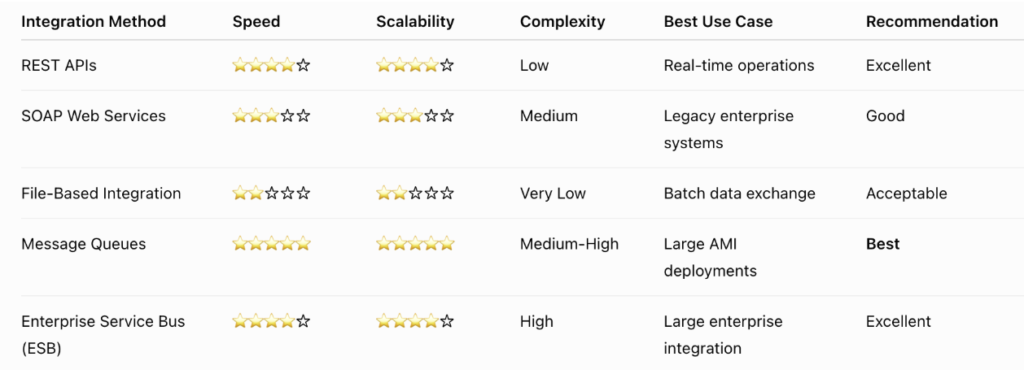
Here’s a detailed comparison from a Smart Metering and Utility perspective.
1. REST APIs
Best suited for:
- Near real-time communication
- Cloud-native deployments
- Lightweight integrations
2. SOAP Web Services
Preferred in legacy enterprise environments where structured XML messaging is required.
3. File-Based Integration
Data exchange through:
- CSV
- XML
- JSON
Transferred securely using:
- SFTP
- FTPS
Suitable for batch processing.
4. Message Queues
Technologies include:
- Apache Kafka
- RabbitMQ
- Azure Service Bus
Ideal for:
- High-volume deployments
- Event-driven architectures
- Reliable asynchronous communication
5. Enterprise Service Bus (ESB)
Middleware solutions such as:
- MuleSoft
- IBM Integration Bus
- Oracle Integration Cloud
Provide routing, orchestration, transformation, and monitoring between enterprise applications.
The right choice depends on data volume, latency requirements, scalability, existing enterprise architecture, and business use case. In modern AMI (Advanced Metering Infrastructure) deployments, utilities often use multiple integration methods together rather than relying on just one.
Common Integration Challenges
Despite mature technologies, utilities often face integration issues.
High Data Volume: Millions of interval readings can overload systems if scalability is not planned.
Time Synchronization Issues: Clock mismatches between meters and servers can result in duplicate or missing intervals.
Duplicate Records: Repeated transmission due to retries or communication failures can create duplicate data.
Communication Failures: Network outages can delay or interrupt data delivery, leading to incomplete datasets.
Master Data Mismatch: Differences in consumer IDs, meter IDs, or asset information between HES and MDM can cause processing failures.
Data Security: Utilities must protect data using TLS encryption, Secure APIs, Digital certificates, Role-based access control or Audit logging.
Best Practices for Successful HES to MDM Integration
- Implement robust Validation, Estimation, and Editing (VEE) rules.
- Use standardized APIs and message formats for interoperability.
- Synchronize system clocks using Network Time Protocol (NTP).
- Validate master data before synchronization.
- Monitor integration performance with automated dashboards and alerts.
- Design scalable architectures using message queues and distributed processing.
- Secure data using encryption, authentication, and access controls.
- Regularly test disaster recovery and failover mechanisms.
Business Benefits
A well-designed HES-to-MDM integration enables utilities to:
- Improve billing accuracy and reduce revenue leakage.
- Ensure high-quality, validated meter data.
- Detect tampering and abnormal consumption patterns.
- Support demand response and load forecasting.
- Enhance outage management and restoration efforts.
- Meet regulatory compliance requirements.
- Enable advanced analytics and digital utility initiatives.
Conclusion
HES-to-MDM integration forms the backbone of every successful smart metering deployment. While the Head End System efficiently collects raw data from smart meters, the Meter Data Management platform transforms that data into reliable, validated, and actionable information for billing, operations, customer service, and regulatory reporting.
As utilities continue to modernize their grids, adopting scalable integration architectures, robust VEE processes, secure communication protocols, and real-time data exchange mechanisms will be essential. A well-implemented HES-to-MDM integration not only improves operational efficiency and billing accuracy but also lays the foundation for advanced analytics, demand-side management, and the future of intelligent energy networks.

0 Comments